

Curriculum and Courses
It is important that you obtain a solid foundation, not only in the basic core of zoology courses, but also in basic chemistry, physics, and mathematics in your study of zoology. This foundation will enable you to pursue a range of different career opportunities later.
You can pursue a Bachelor of Arts (B.A.) or Bachelor of Science (B.S.) in Zoology. The requirements for these two degrees are generally similar, but a B.S. may require more coursework in the physical sciences and the selection of a specialization.
- BIO/MBI 115 Biological Concepts: Ecology, Evolution, Genetics, and Diversity
- CHM 141 College Chemistry
- MBI 121 The Microbial World and Experimenting with Microbes
- MBI 365 Molecular and Cell Biology
Zoology, B.A./B.S. Learning Outcomes
- Locate and cite biology source materials using discipline-specific databases
- Articulate questions and hypotheses that drive research in the field of biology
- Synthesize, evaluate and accurately summarize information from multiple sources
- Integrate core concepts and principles from the biological sciences
- Recognize areas requiring further research
- Comprehend the broader implications of biological research for health
- Effectively communicate scientific information to both non-specialist (popular) and specialist (technical)
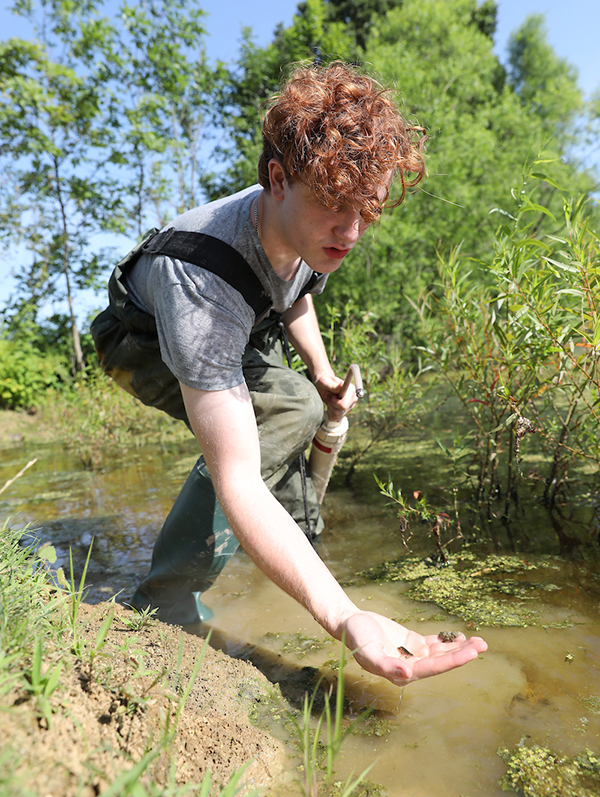
Ty conducts research on macroinvertebrates in 21 different wetland systems around southwest Ohio, looking for clues about why a certain pathogen is causing a significant number of amphibian declines and extinctions.
Career Options
Those who seek employment immediately after graduation find positions in a variety of fields. Our graduates report job titles of naturalist, park technician, assistant pathologist, lab technician, technical sales representative, research technician, museum curator, fisheries manager, environmental planner, municipal zookeeper, environmental impact analyst, and high school biology teacher.
Microbiologists
Investigate the growth, structure, development, and other characteristics of microscopic organisms, such as bacteria, algae, or fungi. Includes medical microbiologists who study the relationship between organisms and disease or the effects of antibiotics on microorganisms.
View Career DetailsZoologists and Wildlife Biologists
Study the origins, behavior, diseases, genetics, and life processes of animals and wildlife. May specialize in wildlife research and management. May collect and analyze biological data to determine the environmental effects of present and potential use of land and water habitats.
View Career DetailsPark Naturalists
Plan, develop, and conduct programs to inform public of historical, natural, and scientific features of national, state, or local park.
View Career DetailsUrban and Regional Planners
Develop comprehensive plans and programs for use of land and physical facilities of jurisdictions, such as towns, cities, counties, and metropolitan areas.
View Career DetailsPharmacists
Dispense drugs prescribed by physicians and other health practitioners and provide information to patients about medications and their use. May advise physicians and other health practitioners on the selection, dosage, interactions, and side effects of medications.
View Career DetailsPhysician Assistants
Provide healthcare services typically performed by a physician, under the supervision of a physician. Conduct complete physicals, provide treatment, and counsel patients. May, in some cases, prescribe medication. Must graduate from an accredited educational program for physician assistants.
View Career DetailsPhysical Therapists
Assess, plan, organize, and participate in rehabilitative programs that improve mobility, relieve pain, increase strength, and improve or correct disabling conditions resulting from disease or injury.
View Career DetailsPhysicians, All Other
All physicians not listed separately.
View Career DetailsRelated Programs
Miami students are an eclectic mix of thinkers, doers, leaders and followers, introverts and extroverts, authors, painters, climbers, coders, pianists, philanthropists, and gamers. Just to name a few.

I knew for a while that I wanted to study Zoology, but I added the Environmental Science co-major when I met other Zoology majors and realized how much crossover there was and how applicable Environmental Science is to my field. Then, I added the Anthropology minor after meeting some majors and taking an Anthropology class that I loved.
Facts and Stats
Your college experience here will be one of the most exciting times of your life. To make sure of this, we’ll provide you with a powerful support system.
-
90%
- of first-year students return for their second year Miami University Data
-
No. 2
- in Ohio and No. 26 nationally among public research universities for 4-year graduation rate IPEDS Data
-
No. 6
- Public university in the U.S. for long-term career success LinkedIn Best Colleges 2025
Admission and Aid
Explore what it means to be a college student at Miami University in Oxford, Ohio, where students prepare to go anywhere and everywhere. We’ll be here to help every step of the way as you prepare for college admission, enrollment, and success.
Contact Us
Undergraduate Admission
Department of Biology
Rich Moore, Ph.D.
Pearson Hall 394
700 E. High St.
Oxford, OH 45056