
Sustainability at Miami
Miami University is committed to sustainability in our academic programs, physical campus and operations, and university mission by promoting environmental stewardship, social responsibility, and economic viability for current and future generations. This commitment is a collaborative effort that involves students, faculty, staff and external partners.

Miami University is committed to carbon neutrality by 2040
A commitment to carbon neutrality and our ongoing efforts toward a more sustainable campus are among the greatest gifts we can give future generations. Higher education institutions are essential in leading the charge for climate action and a more sustainable future. - Miami University President Gregory Crawford

Recent Sustainability News

Sustainability · August 12, 2026 Transforming Billings Hall — North Geothermal Plant — into one of Miami’s most innovative energy facilities
Expansion of geothermal heating and cooling improves efficiency, lowers operating costs, and will help Miami University achieve its 2040 carbon neutrality goal

Campus Life · Sustainability Bringing the song to life: Miami University Natural Areas featured in Men’s Glee Club professional music video
Campus Life • Sustainability

Sustainability · Campus Announcements Preparations begin for groundbreaking at site of new multipurpose arena
Sustainability • Campus Announcements
Decarbonizing campus
-
-50%
- Utility-based carbon emissions reduction (2008-2025)
-
-63%
- Utility-based carbon emissions reduction per building gross square foot (2008-2025)
-
-12%
- Total Greenhouse Gas (MTCO2e; Scopes 1, 2, 3) reduction (PCLC baseline 2019-2025)
Sustainability Dashboard
The Miami 2040 Plan strategy to decarbonize our energy-based emissions is to further reduce energy consumption; complete the transition of building heating and cooling systems off steam; produce zero-emissions energy on-site; procure purchased electricity from renewable sources; and offset the remainder.
View our progress toward decarbonization on the Dashboard.

New projects support Miami 2040 Plan Goals

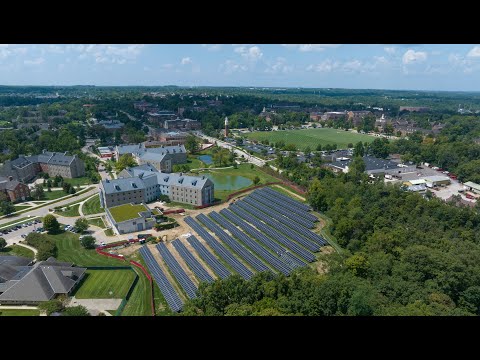
Sharon and Graham Mitchell Sustainability Park and Solar Fields dedicated
The new Sharon and Graham Mitchell Sustainability Park features two solar arrays with more than 3,300 ground mount solar panels that will produce around 2,000 megawatt hours (MWh) of electricity annually. The Western Solar North array sits on top of Miami’s Western Geothermal Well field. Enjoy the park’s walking paths, seating areas, and educational signage.

North Geothermal Plant
The North Geothermal Plant, completed this spring, is located at Billings Hall. Serving buildings on the north part of campus, it uses the heat exchange from 520 wells, each 850 feet deep. New multi-use sports fields and courts will be in place above the north geothermal wellfield by this fall. It will eliminate more than 5,810 metric tons of carbon dioxide equivalents in emissions (MTCO2e) annually.
Sustainability Progress

STARS Gold
Miami achieved its third AASHE STARS (3.0) Gold rating in summer 2025 in recognition of sustainability achievements.

LEED Silver and Gold Certified Buildings
Miami's 36 LEED Silver and Gold-certified buildings (such as Pearson Hall, above) account for 36% of the gross square footage of buildings on the Oxford campus (August 2024).
Waste management: Recycling
Miami makes it easy to recycle: Single stream recycling allows plastics, cardboard, paper, metal, and glass to all be recycled together in one bin.


Academic programs
100% of Miami's Oxford campus academic departments offer sustainability-focused or sustainability-inclusive courses.
Students outside Pearson Hall
Students can choose from one of the five Miami Plan Signature Inquiry areas, including Sustainability and Resilience.

Institute for the Environment and Sustainability The Institute for the Environment and Sustainability (IES) houses Miami's Master's of Environmental Science (M.En.) degree program and four sustainability-related co-majors.
The Institute for the Environment and Sustainability (IES) houses Miami's Master's of Environmental Science (M.En.) degree program and four sustainability-related co-majors.
Sustainability at Miami
-
46
- Oxford campus departments out of 46 offered Sustainability-focused or inclusive courses in 2023-2024
-
170
- More than 170 Sustainability-focused or sustainability-inclusive courses offered in 2023-2024
Community Partners
Promoting sustainability and climate action across the Oxford and Miami communities

GreenHawks
GreenHawks student reporters are devoted to increasing awareness about sustainability on campus, in Oxford, and beyond. Read their stories in The Miami Student.

City of Oxford's Climate Action Plan
The city of Oxford adopted a Climate Action Plan in September 2023. This plan acts as a road map for the Oxford community to achieve carbon neutrality and to ensure Oxford remains thriving despite the changing climate.

Oxford Sustainability Monthly
Monthly roundup of sustainability news and opportunities in the Oxford community.
Get involved
Join a student organization, explore the Miami University Natural Areas, take part in research.

Join a student organization
EcoReps promote sustainable living in Residence Halls through specialty recycling, educational programming, the water bottle project, trash audits and more. Follow them on Instagram @muecoreps. Zero Waste Oxford and the Food Recovery Network are some of the nearly 10 other active sustainability-oriented student organizations on campus.

Take a hike, bird watch, explore Miami's Natural Areas
Did you know nearly half of our 2,000 acre campus is designated as forest? With nearly 1,000 acres and 23 miles of trails in our backyard, the Miami University Natural Areas are an invaluable resource for recreation, teaching, and research.
Timeline: Sustainability Commitments and Goals - Pillars
Miami University's first Sustainability Commitments & Goals (SCAG) were developed in 2010 with broad stakeholder input. The Sustainability Committee established an updated SCAG in 2016. In 2021, the SCAG, having been met or exceeded, were replaced by a set of three Sustainability Pillars.