

Curriculum and Courses
The public health undergraduate curriculum is interdisciplinary, drawing on faculty expertise from multiple departments and two academic colleges. As a public health major, you’ll tailor your studies based on your chosen track. Courses cover key areas of public health science, including epidemiology, health promotion, health disparities, global health, public health policy, and administration. Students explore related fields such as psychology, sociology, and gerontology, gaining insight into both individual and population health. The bachelor’s in public health curriculum prepares students to address real-world challenges in prevention, health equity, and systems-level change.
Human Disease and Epidemiology Track
This concentration utilizes basic concepts in biology and focuses on the factors that cause illness and promote health in human populations. This concentration explores differences in health across time and population subgroups as well as the reasons for those differences.
Health Policy and Administration Track
This concentration focuses on critical policy and programmatic issues in public health. The emphasis of this concentration is to examine how public policy impacts the public health delivery system and how administrators work to develop and implement programs in the field of public health.
Public Health Promotion Track
This concentration examines the principles and practices of health promotion to address current and emerging public health problems. The focus of the concentration is on the development of public health education prevention strategies across the life span.
Common Learning Outcomes
Students graduating with a B.A. in Public Health will be able to:
- identify and address the concepts of population health, and the basic processes, approaches, and interventions which focus on the major health-related needs and concerns of populations.
- describe the basic concepts of legal, ethical, economic, and regulatory dimensions of health care and public health policy.
- integrate the core elements of public health with a selected area of specialization to recognize how the field of public health applies to individuals, communities, and society overall.
Human Disease and Epidemiology Concentration Outcomes
In addition to the common outcomes above, students graduating with this concentration will be able to:
- Describe the underlying science of human health and disease including opportunities for promoting and protecting health across the life course.
- Demonstrate the use of research tools and analytic methods to critically analyze, monitor, and assess the health status of populations and current public health-related issues.
Health Policy and Administration Concentration Outcomes
In addition to the common outcomes above, students graduating with this concentration will be able to:
- Evaluate impact of policies and legislation on individual and population health
- Explain the fundamental characteristics and organizational structure of the U.S. health systems
Public Health Promotion Concentration Outcomes
In addition to the common outcomes above, students graduating with this concentration will be able to:
- Use the basic concepts of public health-specific communication, including technical and professional writing and the use of mass media and electronic technology
- Explain the history and philosophy of public health as well as its core values, concepts, and functions across the globe and in society
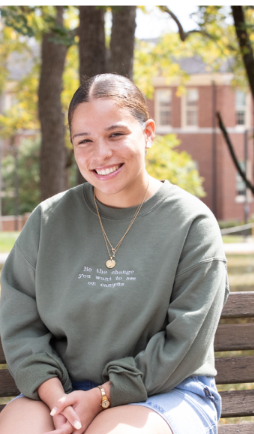
I really got into Public Health, with a focus on Health Policy and Administration, because I worked in the Miami student activities office with over 600 student organizations on campus. I came in the midst of a pandemic, and in order for me to succeed in college and to make this place feel like home, I had to get out of my comfort zone a bit and step out and get involved.
Additional Opportunities


Research with Faculty
Miami students have many opportunities to be involved with research or independent study with faculty through numerous programs including the First Year Research Experience (FYRE). FYRE aims to jumpstart student involvement in research and inquiry at the very start of your college experience.
Careers in Public Health
Graduates of the Public Health major are prepared for a wide range of careers in health promotion, disease prevention, and community wellness. With a bachelor’s in public health, students qualify for entry-level roles in government agencies, nonprofit organizations, and private health-related industries.
Many students continue their education by pursuing a Master of Public Health (MPH) or other advanced degrees, building specialized competencies for leadership roles in public health policy, program management, and epidemiology. The flexibility of the public health undergraduate degree also makes it an excellent foundation for medical, dental, pharmacy, or law school—especially for those completing necessary prerequisites during their undergraduate studies.
Students who seek a career in research may wish to apply to public health M.S./Ph.D. graduate programs.
Possible public health entry-level job titles include:
- Community Education Specialist
- Health Data Analyst
- Health Policy Analyst
- Research Assistant or Research Coordinator
- Prevention Specialist
- Program Coordinator or Consultant
- Health Promotion and Education Specialist
Career Options
Public Health is a broad field that can lead to a number of diverse career opportunities. From epidemiologists who help prevent the spread of disease to community health specialists, environmental scientists, refugee coordinators, policy analysts, health administrators, and health education specialists, there are a wide variety of career choices for students in this field of study. In addition, it is a gateway to pre-professional schools (medical, dental, veterinary, physical therapy, etc.), as well as graduate studies in public health and related fields.
Clinical Research Coordinators
Plan, direct, or coordinate clinical research projects. Direct the activities of workers engaged in clinical research projects to ensure compliance with protocols and overall clinical objectives. May evaluate and analyze clinical data.
View Career DetailsEmergency Management Directors
Plan and direct disaster response or crisis management activities, provide disaster preparedness training, and prepare emergency plans and procedures for natural (e.g., hurricanes, floods, earthquakes), wartime, or technological (e.g., nuclear power plant emergencies or hazardous materials spills) disasters or hostage situations.
View Career DetailsEnvironmental Scientists and Specialists, Including Health
Conduct research or perform investigation for the purpose of identifying, abating, or eliminating sources of pollutants or hazards that affect either the environment or public health. Using knowledge of various scientific disciplines, may collect, synthesize, study, report, and recommend action based on data derived from measurements or observations of air, food, soil, water, and other sources.
View Career DetailsHealthcare Social Workers
Provide individuals, families, and groups with the psychosocial support needed to cope with chronic, acute, or terminal illnesses. Services include advising family caregivers. Provide patients with information and counseling, and make referrals for other services. May also provide case and care management or interventions designed to promote health, prevent disease, and address barriers to access to healthcare.
View Career DetailsHealth Education Specialists
Provide and manage health education programs that help individuals, families, and their communities maximize and maintain healthy lifestyles. Use data to identify community needs prior to planning, implementing, monitoring, and evaluating programs designed to encourage healthy lifestyles, policies, and environments. May link health systems, health providers, insurers, and patients to address individual and population health needs. May serve as resource to assist individuals, other health professionals, or the community, and may administer fiscal resources for health education programs.
View Career DetailsCommunity Health Workers
Promote health within a community by assisting individuals to adopt healthy behaviors. Serve as an advocate for the health needs of individuals by assisting community residents in effectively communicating with healthcare providers or social service agencies. Act as liaison or advocate and implement programs that promote, maintain, and improve individual and overall community health. May deliver health-related preventive services such as blood pressure, glaucoma, and hearing screenings. May collect data to help identify community health needs.
View Career DetailsOptometrists
Diagnose, manage, and treat conditions and diseases of the human eye and visual system. Examine eyes and visual system, diagnose problems or impairments, prescribe corrective lenses, and provide treatment. May prescribe therapeutic drugs to treat specific eye conditions.
View Career DetailsMedical and Clinical Laboratory Technologists
Perform complex medical laboratory tests for diagnosis, treatment, and prevention of disease. May train or supervise staff.
View Career DetailsRelated Programs
Miami students are an eclectic mix of thinkers, doers, leaders and followers, introverts and extroverts, authors, painters, climbers, coders, pianists, philanthropists, and gamers. Just to name a few.
Facts and Stats
Your college experience here will be one of the most exciting times of your life. To make sure of this, we’ll provide you with a powerful support system.
-
90%
- of first-year students return for their second year Miami University Data
-
No. 2
- in Ohio and No. 26 nationally among public research universities for 4-year graduation rate IPEDS Data
-
No. 6
- Public university in the U.S. for long-term career success LinkedIn Best Colleges 2025
Admission and Aid
Explore what it means to be a college student at Miami University in Oxford, Ohio, where students prepare to go anywhere and everywhere. We’ll be here to help every step of the way as you prepare for college admission, enrollment, and success.
Contact Us
Undergraduate Admission
Public Health
College of Arts and Science
Bishop Circle 100
Oxford, OH 45056
Public Health Advisors
Kelly Abshire, Ph.D. (Human Diseases and Epidemiology)
Pearson 91
Sara McLaughlin (Health Policy and Administration)
Upham Hall 358
Paul Branscum (Public Health Administration)