

Curriculum and Courses
The Physics B.S. degree at Miami University offers a rigorous academic foundation for students pursuing graduate study or careers in applied physics, engineering physics, biomedical engineering, or medical school. As one of the top physics universities, Miami prepares students for diverse pathways—including teacher licensure in physics, or physics-related careers in business, law, or technology.
Below are several of the required courses:
- PHY 181 General Physics I
- PHY 182 General Physics II
- PHY 292 Electronic Instrumentation
- PHY 401 Physics Assessment Examination
- MTH 151 Calculus I
- MTH 222 Introduction to Linear Algebra
There are two concentration areas that will allow the student to expand on specific areas:
- Advanced Physics – designed for students interested in continuing graduate studies or those wanting a broad theoretical background.
- Biological Physics – designed for students interested in biophysics, physics related biomedical fields, or medical school.
Physics, B.S. Learning Outcomes
- Communicate clearly;
- Demonstrate critical thinking by using appropriate mathematical techniques and physics concepts to obtain quantitative solutions to problems;
- Demonstrate critical thinking by conducting scientific investigations (experimental, numerical or theoretical);
- Acquire a body of knowledge that includes classical physics, relativity, statistical mechanics/thermodynamics, and quantum mechanics.
Combined Physics B.S./M.S. Degree Program
The combined bachelor’s–master’s program lets highly qualified students pursue both the Physics, B.S. and the Physics M.S. degrees concurrently. Students interested in this option should consult the program’s graduate director early, as it requires advance planning.

The physics department is a small and tight community, allowing me to participate in undergraduate research and various other opportunities that wouldn’t have been possible in larger departments. Miami university is also such a beautiful campus and rich in history.
Research Opportunities
Astrophysics
Numerical simulations with gravitational N-body codes
Atomic, molecular, and optical physics
Laser and time-resolved polarization spectroscopy, laser-induced fluorescence in molecules, quantum beat spectroscopy, et.al.
Biophysics and soft condensed matter physics
Techniques to model and understand complex materials such as living biological systems and nano-materials
Computational physics
Scientific visualization, image processing and analysis, computer graphics and animation
Condensed matter physics
Fabrication and characterization of nanoscale materials via electron beam lithography and photolithography, et.al.
Physics education
Strategies for teaching scientific reasoning and problem-solving skills
Quantum optics and information
Spectroscopy of cold atoms in optical lattices,
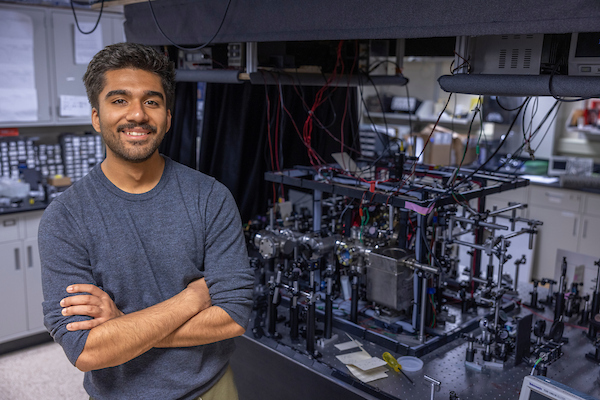
I work with cold atoms in optimal lattices, and we are studying the principle of Brownian ratcheting. This has a lot of applications to nanotechnology, like building artificially efficient nanomachines for medicine, industry, and technology. The people I’ve met in the Department of Physics have all played their part in pushing me to get to where I know I can be.
Careers in Physics
Students earning a bachelor of science degree in physics from Miami University graduate with strong analytical, mathematical, and scientific skills—preparing them for a wide array of career paths. Approximately 60% of our majors pursue graduate or professional programs in physics, engineering, biomedical fields, business and entrepreneurship, law, education, or medicine.
Those not continuing their formal education find employment across scientific and technical industries, often in high-demand areas such as the semiconductor sector, optics and photonics, military service, or technical sales. A Physics B.S. also opens doors to roles in business operations, technology consulting, or marketing for scientific and engineering firms. Teaching, particularly with physics teacher licensure, remains a rewarding and in-demand path for many graduates.
Additional physics career information can be found at aps.org/careers.
Career Options
About 60 percent of our physics graduates attend graduate or professional school, specializing in physics, engineering, business, law, education, or medicine. After further education, other careers include those in computational science or the physical sciences such as meteorology or oceanography.
Geographic Information Systems Technologists and Technicians
Assist scientists or related professionals in building, maintaining, modifying, or using geographic information systems (GIS) databases. May also perform some custom application development or provide user support.
View Career DetailsMechanical Engineers
Perform engineering duties in planning and designing tools, engines, machines, and other mechanically functioning equipment. Oversee installation, operation, maintenance, and repair of equipment such as centralized heat, gas, water, and steam systems.
View Career DetailsNanosystems Engineers
Design, develop, or supervise the production of materials, devices, or systems of unique molecular or macromolecular composition, applying principles of nanoscale physics and electrical, chemical, or biological engineering.
View Career DetailsBiochemists and Biophysicists
Study the chemical composition or physical principles of living cells and organisms, their electrical and mechanical energy, and related phenomena. May conduct research to further understanding of the complex chemical combinations and reactions involved in metabolism, reproduction, growth, and heredity. May determine the effects of foods, drugs, serums, hormones, and other substances on tissues and vital processes of living organisms.
View Career DetailsBiologists
Research or study basic principles of plant and animal life, such as origin, relationship, development, anatomy, and functions.
View Career DetailsAstronomers
Observe, research, and interpret astronomical phenomena to increase basic knowledge or apply such information to practical problems.
View Career DetailsMaterials Scientists
Research and study the structures and chemical properties of various natural and synthetic or composite materials, including metals, alloys, rubber, ceramics, semiconductors, polymers, and glass. Determine ways to strengthen or combine materials or develop new materials with new or specific properties for use in a variety of products and applications. Includes glass scientists, ceramic scientists, metallurgical scientists, and polymer scientists.
View Career DetailsSales Representatives, Wholesale and Manufacturing, Technical and Scientific Products
Sell goods for wholesalers or manufacturers where technical or scientific knowledge is required in such areas as biology, engineering, chemistry, and electronics, normally obtained from at least 2 years of postsecondary education.
View Career DetailsRelated Programs
Miami students are an eclectic mix of thinkers, doers, leaders and followers, introverts and extroverts, authors, painters, climbers, coders, pianists, philanthropists, and gamers. Just to name a few.
Facts and Stats
Your college experience here will be one of the most exciting times of your life. To make sure of this, we’ll provide you with a powerful support system.
-
90%
- First-to-second year retention Miami University Data
-
12th
- Among Public Universities in the United States for Four-Year Graduation Rate The Chronicle of Higher Education Almanac
-
#6
- Public university in the U.S. for long-term career success LinkedIn Best Colleges 2025
Admission and Aid
Explore what it means to be a college student at Miami University in Oxford, Ohio, where students prepare to go anywhere and everywhere. We’ll be here to help every step of the way as you prepare for college admission, enrollment, and success.
Contact Us
Undergraduate Admission
Department of Physics
Karthik Vishwanath, Ph.D.
Lead Departmental Advisor
109 Kreger Hall
500 E. Spring St.
Oxford, OH 45046