

Curriculum and Courses
Our department has a core curriculum for the first two years that provides the necessary groundwork in chemistry, physics, and math for all of our majors. In the third year, our degree tracks diverge to meet the specific goals of our programs. The curriculum for the Bachelor of Science in Chemistry degree includes advanced courses in areas such as polymer chemistry, spectroscopy, instrumental analysis, and inorganic chemistry. Laboratory work is an integral part of the program. This program is accredited by the American Chemical Society.
The Chemistry, B.S. includes the following focusses: Environmental Focus; Engineering Focus; Forensics Focus; Pharmaceutical Sciences Focus; and Foods, Flavors, Fermentation Focus.
Students who anticipate graduate study in chemistry should elect the B.S. Chemistry Program.
The Bachelor of Arts degree is designed to provide students with a solid foundation in chemistry, with the flexibility to pursue other interests including other majors, study abroad, or extensive work or volunteer activities. This degree can be taken in a teaching certification track, which requires additional related credit hours taken from the College of Education, Health, and Society and results in teaching certification.
The Technical Management and Sales focus is for the student looking for a career in areas such as technical sales, technical management, or patent examination; or wishing to pursue law school.
Chemistry, B.A/B.S. Learning Outcomes
- Describe, synthesize, and critique the methodological approaches presented in primary references (peer-reviewed journal articles in chemistry/biochemistry) and/or generated in student-led research
- Explain and synthesize chemistry concepts presented in laboratory research scenarios
- Write well-organized, clear, logical, grammatically correct literature critiques and laboratory reports
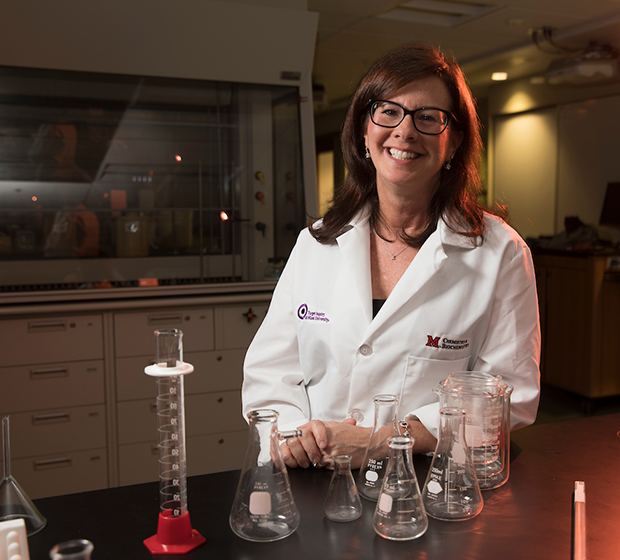
I want people to be focused on students; how they learn, what’s best for them, what’s best for understanding chemistry, and then use that to weave together a classroom that stimulates growth in understanding chemical ideas.
Additional Opportunities

Undergraduate Research
One of the core values of the Department of Chemistry and Biochemistry is that undergraduate involvement in our research program is among the most important opportunities we can offer our students. Research labs present great opportunities to learn chemistry. You will be able to see how chemistry is used to solve problems and learn to draw from your fundamental knowledge of chemistry. You will be surprised how much you remember once you have a real situation to apply it to. All of our undergraduates are encouraged to seek out research opportunities.

Chemistry and Biochemistry Alumni Mentorship Program
Students will be paired with an alumnus working professionally in the field and who has interests and experiences that overlap with the student’s goals. The pair will interact regularly to build relationships and facilitate the student’s next steps after graduation.

Chemistry and Biochemistry Internship Program
In collaboration with our Alumni Board and the Center for Career Exploration and Success, the CHM Department is committed to connecting undergraduate chemistry and biochemistry majors with meaningful internship opportunities to apply their learning gains and advance their career aspirations. We work with the handshake platform to match students with internship programs.
Career Options
Many graduates in chemistry go on to graduate school in chemistry, or related areas such as polymer chemistry, chemical engineering or environmental science. Other students elect professional schools in the health sciences including medical school, dental school, or pharmacy school. Some students may pursue law school, teacher certification, or training in data analytics and informatics.
Nanosystems Engineers
Design, develop, or supervise the production of materials, devices, or systems of unique molecular or macromolecular composition, applying principles of nanoscale physics and electrical, chemical, or biological engineering.
View Career DetailsFood Scientists and Technologists
Use chemistry, microbiology, engineering, and other sciences to study the principles underlying the processing and deterioration of foods; analyze food content to determine levels of vitamins, fat, sugar, and protein; discover new food sources; research ways to make processed foods safe, palatable, and healthful; and apply food science knowledge to determine best ways to process, package, preserve, store, and distribute food.
View Career DetailsBiochemists and Biophysicists
Study the chemical composition or physical principles of living cells and organisms, their electrical and mechanical energy, and related phenomena. May conduct research to further understanding of the complex chemical combinations and reactions involved in metabolism, reproduction, growth, and heredity. May determine the effects of foods, drugs, serums, hormones, and other substances on tissues and vital processes of living organisms.
View Career DetailsMolecular and Cellular Biologists
Research and study cellular molecules and organelles to understand cell function and organization.
View Career DetailsBiologists
Research or study basic principles of plant and animal life, such as origin, relationship, development, anatomy, and functions.
View Career DetailsEpidemiologists
Investigate and describe the determinants and distribution of disease, disability, or health outcomes. May develop the means for prevention and control.
View Career DetailsAstronomers
Observe, research, and interpret astronomical phenomena to increase basic knowledge or apply such information to practical problems.
View Career DetailsChemists
Conduct qualitative and quantitative chemical analyses or experiments in laboratories for quality or process control or to develop new products or knowledge.
View Career DetailsMaterials Scientists
Research and study the structures and chemical properties of various natural and synthetic or composite materials, including metals, alloys, rubber, ceramics, semiconductors, polymers, and glass. Determine ways to strengthen or combine materials or develop new materials with new or specific properties for use in a variety of products and applications. Includes glass scientists, ceramic scientists, metallurgical scientists, and polymer scientists.
View Career DetailsEnvironmental Scientists and Specialists, Including Health
Conduct research or perform investigation for the purpose of identifying, abating, or eliminating sources of pollutants or hazards that affect either the environment or public health. Using knowledge of various scientific disciplines, may collect, synthesize, study, report, and recommend action based on data derived from measurements or observations of air, food, soil, water, and other sources.
View Career DetailsChemistry Teachers, Postsecondary
Teach courses pertaining to the chemical and physical properties and compositional changes of substances. Work may include providing instruction in the methods of qualitative and quantitative chemical analysis. Includes both teachers primarily engaged in teaching, and those who do a combination of teaching and research.
View Career DetailsDentists, General
Examine, diagnose, and treat diseases, injuries, and malformations of teeth and gums. May treat diseases of nerve, pulp, and other dental tissues affecting oral hygiene and retention of teeth. May fit dental appliances or provide preventive care.
View Career DetailsPharmacists
Dispense drugs prescribed by physicians and other health practitioners and provide information to patients about medications and their use. May advise physicians and other health practitioners on the selection, dosage, interactions, and side effects of medications.
View Career DetailsPreventive Medicine Physicians
Apply knowledge of general preventive medicine and public health issues to promote health care to groups or individuals, and aid in the prevention or reduction of risk of disease, injury, disability, or death. May practice population-based medicine or diagnose and treat patients in the context of clinical health promotion and disease prevention.
View Career DetailsRelated Programs
Miami students are an eclectic mix of thinkers, doers, leaders and followers, introverts and extroverts, authors, painters, climbers, coders, pianists, philanthropists, and gamers. Just to name a few.
Biochemistry, B.A., B.S.
Major
Read MoreBiomedical Engineering, B.S.
Major
Read MoreChemical and Biomedical Engineering, M.S.
Graduate Program
Read MoreChemical Engineering, B.S.
Major
Read MoreChemistry, M.S., Ph.D.
Graduate Program
Read MorePaper Science
Minor
Read MorePremedical and Pre-Health Studies
Co-Major
Read MoreFacts and Stats
Your college experience here will be one of the most exciting times of your life. To make sure of this, we’ll provide you with a powerful support system.
-
90%
- of first-year students return for their second year Miami University Data
-
No. 2
- in Ohio and No. 26 nationally among public research universities for 4-year graduation rate IPEDS Data
-
No. 6
- Public university in the U.S. for long-term career success LinkedIn Best Colleges 2025
Admission and Aid
Explore what it means to be a college student at Miami University in Oxford, Ohio, where students prepare to go anywhere and everywhere. We’ll be here to help every step of the way as you prepare for college admission, enrollment, and success.
Contact Us
Undergraduate Admission
Department of Chemistry and Biochemistry
Jill Page, Ph.D.
Heeyoung Tai, Ph.D.
Lead Departmental Advisors
Hughes Laboratories 346 and 239
701 E. High St.
Oxford, OH 45056